Wondering which LA helicopter route fits your vibe? Malibu’s wide beaches, glowing bluffs, and quiet canyons give you smooth air, crisp detail, and celebrity coastline intrigue. Slide south for Santa Monica’s pier theatrics, Venice canals, and Marina del Rey’s sculpted harbor at sunset. Shift east and the Hollywood Corridor tightens the frame—sign, studios, and hills—before Griffith Park opens to Observatory symmetry. Downtown caps it with neon skyline flybys. Choose short hops for precision or grand loops for narrative—and see what each reveals.
Malibu Coastal Highlights: Beaches, Bluffs, and Celebrity Enclaves
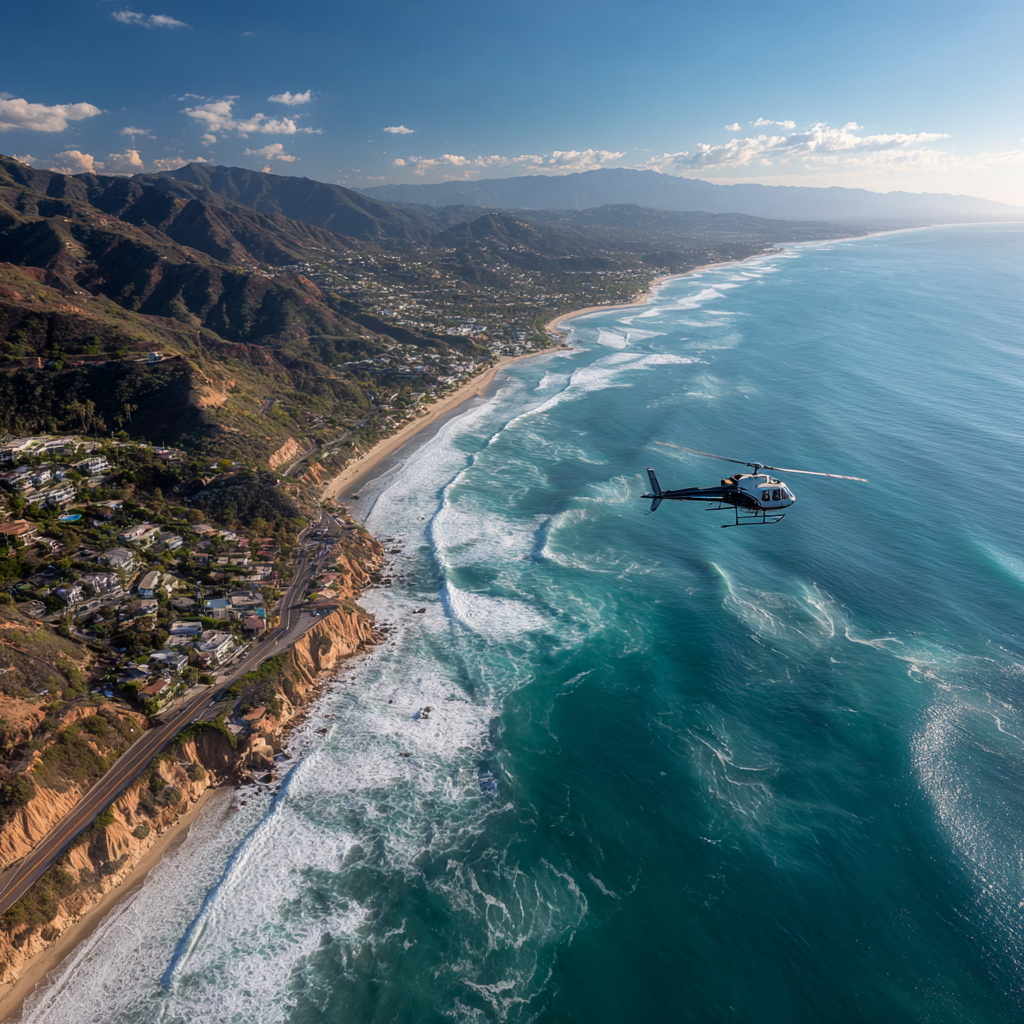
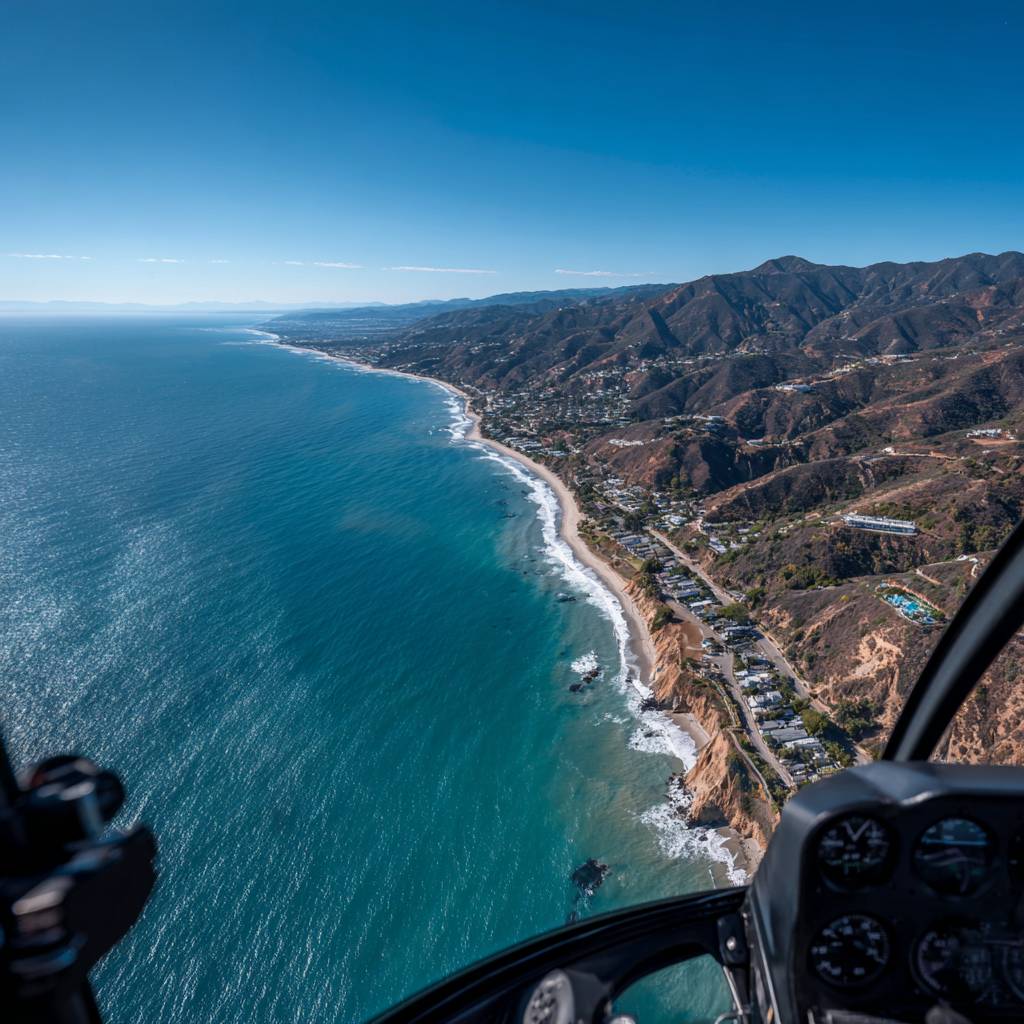
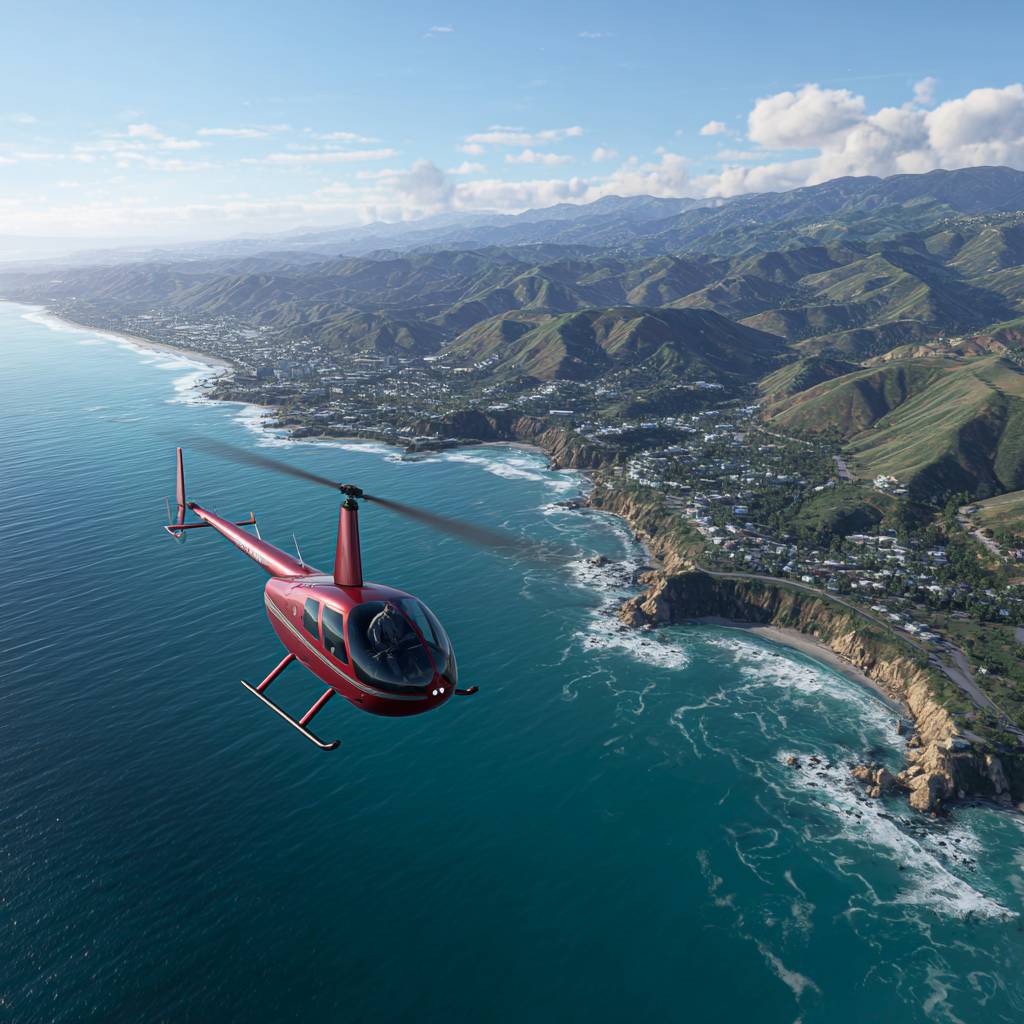
Skimming west from Santa Monica, you trace Malibu’s serrated edge where wide, sun-lit beaches give way to ochre bluffs and secluded canyons, a sharper contrast than anywhere else along LA’s shore. From the cockpit, the coastline reads like a living gradient: Zuma’s broad sands taper into Point Dume’s cliffs, then fractal into coves that feel private even at noon. Compared with urban corridors, visibility here stretches farther, letting you map tide lines, kelp beds, and Malibu wildlife with surgical clarity. You’ll also clock celebrity homes tucked behind windbreaks—minimalist cubes beside mid-century glass—revealing how architecture negotiates salt, wind, and view. The route’s appeal isn’t speed; it’s resolution. You perceive microclimates, sediment seams, and traffic-free continuity that no boulevard or beach path can match.
Pacific Palisades to Santa Monica: Pier, Promenade, and Coastal Parks
From the Pacific Palisades, you track the coastline as the Santa Monica Pier appears like a bright compass rose, busier and more theatrical than Malibu’s quiet coves. Shift inland and you’ll compare the open-air rhythm of Third Street Promenade to the boardwalk’s carnival energy, spotting patterns of street life you can’t read from the ground. Along the coastal bluffs and parks, the terraces of green frame the ocean with cleaner sightlines than beach level, giving you layered perspectives from surf to skyline.
Iconic Santa Monica Pier
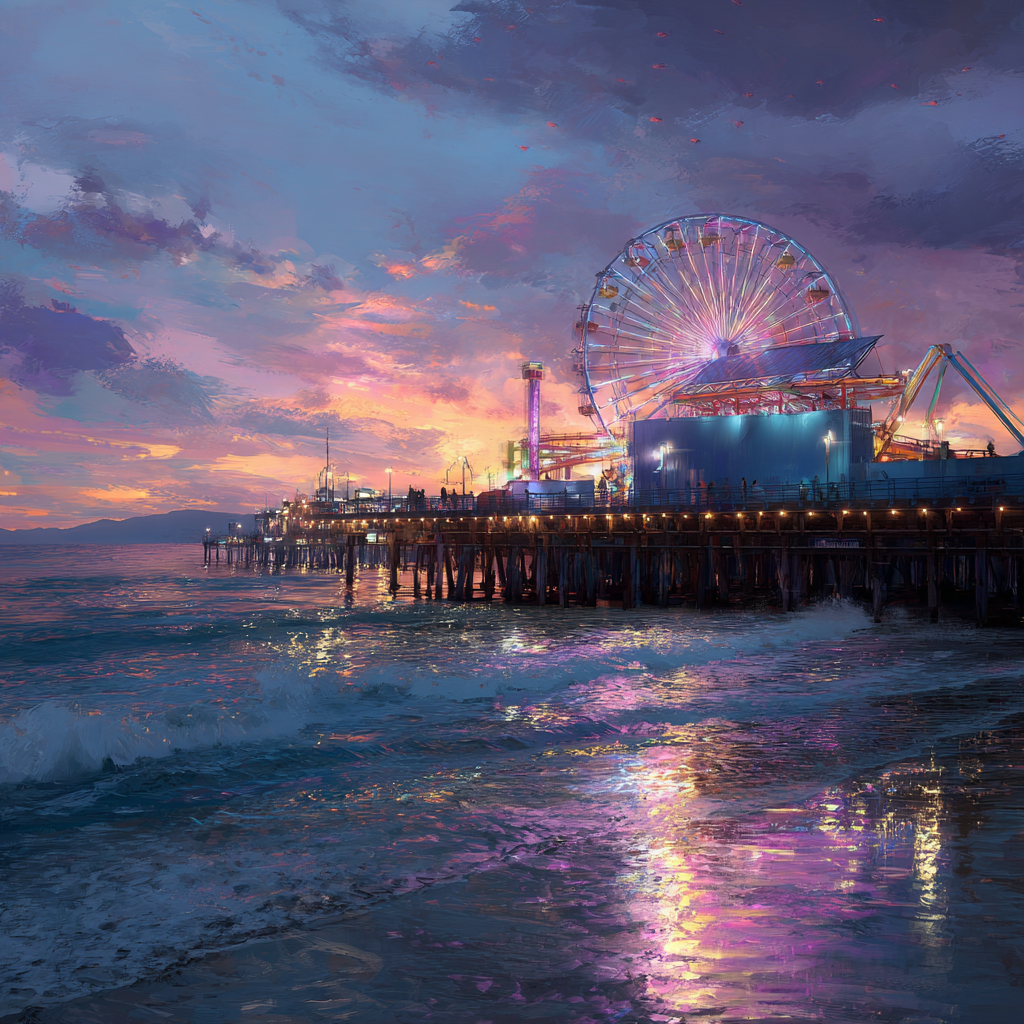
Carousel-bright and salt-sprayed, the stretch from Pacific Palisades to the Santa Monica Pier swaps wild bluffs for a lively, human-scaled coast. From the cockpit, you watch Santa Monica pivot from cliffside calm to kinetic color: the Ferris wheel, timber trusses, and surf lines forming clean, legible geometry. Compared with Malibu’s rugged sprawl, the pier’s grid reads like an interface—concise, designed, iterative.
You trace pier history in a single pass: utility dock to pleasure pier to renewable-lit icon, a timeline encoded in planks and pylons. Below, local cuisine anchors the shoreline economy—sea-to-table kiosks, quick-fire tacos, and inventive sweets—while beach paths route people like efficient data packets. You prefer this segment when testing new camera rigs; the predictable patterns sharpen contrast without sacrificing surprise.
Third Street Promenade Views
Leave the pier’s clean geometry off your left and slide inland a few blocks, where Third Street Promenade compresses the coastline’s openness into a pedestrian canyon of storefronts, buskers, and canopy trees. From the helicopter, you read the grid like a dashboard: Third Street’s linear rhythm, plazas pulsing with Promenade Attractions, and pockets where Street Performers pull micro-crowds into orbit. Compared to the pier’s carnival logic, this corridor feels curated—retail latticed with culture.
You don’t just scan; you benchmark. The Shopping Experience here scales vertically: rooftops with solar arrays, adaptive façades, and alleyways acting as data-friendly arteries for deliveries and pop-ups. Movement patterns reveal what ground-level misses—shaded nodes outperform sunny corners, and intersections become stages. In minutes, you map preference, flow, and opportunity.
Coastal Bluffs and Parks
Even as the shoreline flexes its broad, glittering arc, the terrain abruptly lifts into coastal bluffs where parks stitch green edges to blue water. From Pacific Palisades to Santa Monica, you compare tiers of experience in minutes: rugged overlooks, landscaped lawns, and the kinetic draw of the Pier. From above, the bluffs read like a living interface—coastal ecosystems absorbing wind, salt, and footfall—while Santa Monica’s grids test how cities meet the sea.
Compared to inland routes, this segment feels both wilder and more curated. You track trails cutting through sage and ice plant, then pivot to the Promenade’s geometry and the carousel’s nostalgia. The helicopter’s perspective underscores park conservation tradeoffs: habitat buffers versus public access, stormwater design versus scenic priority, resilience versus spectacle.
Venice and Marina Del Rey: Canals, Harbor Curves, and Sunset Light
While the city unwinds below you, Venice’s fingerlike canals and Marina del Rey’s sweeping harbor arcs reveal two distinct geometries of water and light. You trace angular footbridges and mirrored bungalows, then pivot to the marina’s concentric slips and regimented masts—precision versus improvisation. Sunset compresses color: canals glow amber; the harbor burns copper. You spot waterway wildlife threading the inlets, while Beachfront dining terraces flicker on, calibrating the shoreline’s social pulse. Compared to bluff routes, this pass is intimate, data-dense, and cinematic.
- Canal grid: asymmetry that invites curiosity, with serpentine reflections amplifying depth cues and rhythm.
- Harbor logic: engineered curves optimizing flow, sightlines, and nautical choreography at scale.
- Golden-hour payload: softer contrasts that sharpen pattern recognition and elevate spatial decision-making.
The Hollywood Corridor: Sign, Hills, and Studio Backlots
From water geometry to land iconography, you bank inland and climb toward the Hollywood Corridor, where signage, chaparral hillsides, and studio grids replace canals and slips. The coastline’s soft curves give way to angular backlots, soundstages, and lettered slopes that broadcast ambition. Compared to Venice’s reflective calm, this route feels kinetic—prop blades skimming over a live storyboard of Hollywood history.
You track the ridgeline, reading neighborhoods like frames: Beachwood’s stair-stepped roofs, Cahuenga’s cut, and the marquee sprawl of Sunset. Below, studio lots map out logistics—backdrops, blue screens, and street sets—revealing the city’s prototyping spirit. You’re as likely to clock celebrity sightings as traffic patterns, yet the real distinction is systemic: here, narrative architecture dominates, turning terrain into IP and the skyline into a production pipeline.
Griffith Park and Observatory: Canyons, Planetarium Dome, and Night Views
Though the studios recede behind you, Griffith Park opens like a relief map—canyons ribbing the hills, fire roads etching switchbacks toward the Observatory’s white dome. From this altitude, you read terrain like code: dry washes, chaparral seams, and ridgelines converging on the planetarium’s precise geometry. Compared to the Hollywood Corridor, this route trades billboard flash for topographic intelligence—less spectacle, more structure.
You bank along the dome’s curve, where glass catches dusk and the city begins to glow. Griffith Park becomes a dark canvas; the Observatory, a bright cursor. Night Views sharpen contrast, turning canyons into negative space and neighborhoods into pixel grids.
- Compare ridge-to-ridge crosswinds with smoother basin air for a cleaner orbit
- Time dusk passes to sync alpenglow with city ignition
- Choose tighter circuits to prioritize Observatory detail over panorama
Downtown LA Skyscrapers: Skyline Flybys, Landmarks, and Neon Nights
Leave the dark contours of Griffith behind and aim east, where the skyline stacks its own mountains in steel and light. From this angle, Downtown’s towers feel engineered for flight: glass planes tilt like wings, helipads curl into targets, and streets sketch circuits of energy. You skim past the U.S. Bank Tower and Wilshire Grand, reading their façades as a live index of skyscraper architecture—sleek, sensor-bright, and aerodynamically persuasive.
Compared to canyon loops, this route trades silence for circuitry. Neon threads along Broadway and the Arts District, signaling a different altitude of urban nightlife: rooftops pulsing, murals glowing, metros gliding. You don’t just observe; you prototype perspectives—testing height against horizon, density against dusk. Downtown rewards iteration, each pass sharpening detail, each banked turn revealing systems at work.
Flight Durations and Routes Compared: Short Hops vs. Grand Loops
While the city’s grid slides beneath you, the clock becomes the clearest instrument for choosing a route: short hops compress spectacle into crisp vignettes, while grand loops stretch time into a narrative arc. You’re deciding between immediacy and immersion. Short hops deliver distilled highlights—Malibu cliffs, a swift downtown sweep, a coastline pivot—then set you back on the pad before your pulse slows. Grand loops stitch districts into a single storyline, connecting shoreline, canyons, and skyline with deliberate cadence.
- Short hops: agile, surgical, and budget-efficient; perfect when you want precision over breadth and minimal turnaround.
- Grand loops: panoramic, immersive, and systems-level; ideal when you want connective context and layered perspectives.
- Choose by intent: prototype a route with short hops, then scale into grand loops for a thorough, architected experience.
Best Times to Fly: Golden Hour, Twilight, and Crystal-Clear Mornings
Because light shapes LA as much as skyline and sea, timing your lift-off matters as much as the route. At golden hour, Malibu’s bluffs glow, the Pacific turns to liquid metal, and shadows carve depth into the Santa Monica range; Downtown’s glass towers warm to copper, giving you sculptural contrast and cleaner detail. Twilight flights shift the palette: the basin becomes neon circuitry, freeways trace light ribbons, and the skyline’s silhouette sharpens against a cobalt gradient—less detail in the hills, more drama in the cores.
Crystal-clear mornings reward precision. Marine layer permitting, you’ll see crisp ridgelines, uncluttered coastline, and disciplined color across Griffith, Hollywood, and the South Bay. If you prioritize accuracy and range, fly early; if you want cinematic texture, choose sunset; for urban theatre, go twilight.
Who Each Route Suits: First-Timers, Photographers, Romance, and Thrill-Seekers
You’ll notice each route plays to a different strength: smooth coastal loops calm first-timers, while precise city circuits reward photographers with clean sightlines and iconic angles. If you crave speed, tight banks over the canyons and skyline give thrill-seekers the heart‑pound without sacrificing safety. Compare how stable altitudes favor crisp shots, gentle turns ease newbies in, and dynamic maneuvers trade serenity for adrenaline.
Ideal for First-Timers
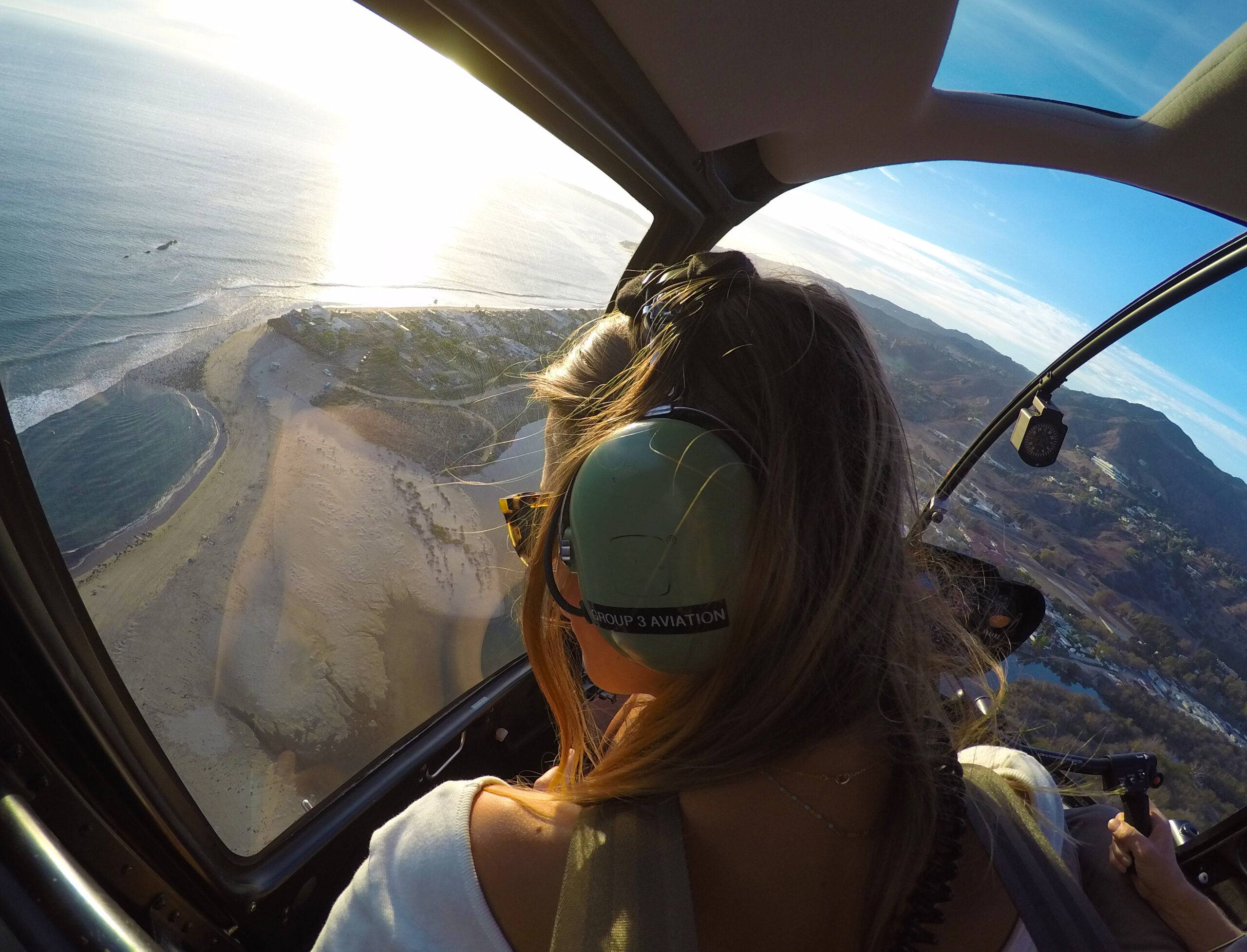
Even if you’ve never set foot in a chopper, some LA routes make easing in feel effortless. For first time experiences, you’ll feel most comfortable on coastal tracks from Malibu to Santa Monica—smooth air, graceful turns, and wide-open views lower the learning curve. Compare that to Downtown loops: they’re punchier, tighter, and better once you’ve banked a little confidence. Griffith Park and the Hollywood Sign corridor split the difference—iconic sights with gentle altitude changes and short segments that let you acclimate quickly. Use these beginner tips to pick a route that matches your comfort with motion, noise, and height.
- Choose coastal routes for steadier air and progressive banking.
- Opt for 25–35 minute flights to minimize fatigue and maximize novelty.
- Sit front-left for the best horizon reference and calmer visuals.
Best for Photographers
Comfort comes first, but sharp images ask for different choices than beginner-friendly laps. If you’re shooting, pick routes that hold altitude and offer predictable lines: the Malibu coastline for golden-hour texture, Griffith Observatory passes for symmetry, and Downtown LA orbits for geometry and reflections. You’ll get cleaner horizons over water, richer contrast over hills, and dynamic grids over glass.
Use these photography tips: request doors-on with bubble windows for stability, or doors-off for unobstructed frames; ask pilots for slow, 360-degree orbits at consistent altitudes. Dial aerial settings for motion and vibration: shutter 1/800–1/1000 for crisp cityscapes, 1/250–1/320 for slight rotor blur; ISO auto with caps; continuous AF; burst mode. Compare light: coastal haze softens; downtown after sunset glows—both reward deliberate pacing.
Perfect for Thrill-Seekers
While LA’s skyline charms at a glide, thrill-seekers chase routes that dive, bank, and thread landmarks at close range. You’ll feel the difference the moment the pilot tilts toward the Hollywood Sign, carves along the Cahuenga Pass, then slingshots downtown, skimming the glass of Wilshire towers before a tight orbit over City Hall. Compared to Malibu’s serene coastal sweep, these city-centric tracks favor steep shifts, tighter corridors, and rapid altitude changes—pure thrill seeking experiences engineered for control and precision. Sunset runs amplify motion with thermals; night flights sharpen speed with luminous reference points. If you crave adrenaline pumping adventures without sacrificing situational awareness, choose routes that emphasize dynamic maneuvers over long vistas.
- Quick-banked skyline circuits
- Canyon-to-downtown shift sprints
- Night orbits with illuminated waypoints
Conclusion
From Malibu’s rugged bluffs to DTLA’s neon canyons, you’ve got routes that trade intimacy for spectacle, serenity for skyline drama. Prefer quick coastal hops or sweeping grand loops that stitch beach, hills, and glass into one story? Golden hour flatters Malibu; twilight electrifies downtown; crystal mornings sharpen the Hollywood Corridor. First-timer, photographer, romantic, thrill-seeker—you’ll match a flight to your mood. The only question left: which lens on Los Angeles do you want to carry home?